

what's inside
An entire sheet, nothing more.
Matcha is not an infusion: you drink the leaf itself, ground into a powder. Everything it contains ends up in your cup.

composition
Three molecules, one balance.
L-theanine
An amino acid concentrated by weeks of shading. It gives matcha its umami taste and slows down caffeine absorption.
Catechins
The green tea polyphenol family. Because the whole leaf is consumed, more is absorbed than with a classic infusion.
Chlorophyll
Produced in abundance under shade cloths, it is responsible for the vibrant, never dull, jade green color of quality matcha.
energy
A gradual increase
The caffeine in matcha is bound to L-theanine, which slows its absorption. The effect comes on gently and subsides in the same way, whereas coffee takes effect quickly and then wears off abruptly.

whole leaf
Nothing remains in the filter
An infusion extracts some of what the leaf contains, then the rest is discarded. With matcha, the leaf is ground into powder and consumed whole.

digestion
Acidity-free
Matcha is prepared at 70 or 75 degrees Celsius and remains low in acidity. Many people who have trouble with coffee on an empty stomach experience no discomfort with matcha.

focus
Attentive without being tense
It's the combination of caffeine and L-theanine that makes the difference: you get the focus, but without the jitters or nervousness associated with strong coffee.

ritual
Two minutes for yourself
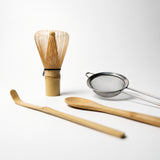
Sift, pour, whisk. Matcha requires a gesture, and this gesture demands a pause. Many of our customers say it's this moment they seek as much as the drink itself.

matcha and coffee
Two ways to start the day.
| Matcha | Café | |
|---|---|---|
| Caffeine | 25 to 70 mg depending on the dosage | 80 to 120 mg per cup |
| Rise | Gradual, over several hours | Quickly, in twenty to thirty minutes |
| Descent | Smooth, with no noticeable jolt | Often brutal |
| Acidity | Weak | Raised |
| Preparation | Two minutes, whisk or frother | Machine or filter |
| Taste | Umami, vegetal, slightly sweet | Roasted, bitter |
The values given are orders of magnitude for a standard serving. Matcha is not a substitute for coffee; it offers something different.
Three ranks, one origin.
The same Uji matcha, selected differently depending on its intended use.


